


Gb13 guitar chord, an extended variation of the dominant 13th chord, adds a rich and sophisticated sound to any musical piece. This chord, featuring a combination of extended intervals, offers a complex yet harmonious blend that can elevate your guitar playing to new heights.
Editor’s Notes: Why is understanding the Gb13 guitar chord important?
Understanding the Gb13 guitar chord empowers guitarists to expand their harmonic vocabulary, enhance their improvisation skills, and create captivating chord progressions. Whether you’re a seasoned musician or just starting to explore extended chords, this guide will provide you with a comprehensive understanding of the Gb13 chord, equipping you to incorporate it effectively into your musical endeavors.
1. Key Differences or Key Takeaways
| Characteristic | Gb13 Guitar Chord |
|---|---|
| Root Note: | Gb |
| Chord Structure: | 1-3-5-b7-9-11-13 |
| Quality: | Extended Dominant |
| Commonly Used In: | Jazz, Fusion, Blues |
2. Transition to Main Article Topics
- Voicings and Inversions: Exploring different voicings and inversions of the Gb13 chord to create diverse harmonic textures.
- Harmonic Function: Understanding the role of the Gb13 chord in chord progressions and its ability to create tension and resolution.
- Improvisation Applications: Unleashing the potential of the Gb13 chord for improvisation, outlining scales, and creating melodic lines.
- Musical Examples: Showcasing real-world examples of how the Gb13 chord is used in famous songs and solos.
- Practice Tips: Providing practical exercises and tips to help you master the Gb13 guitar chord and incorporate it into your playing.
3. Voicings
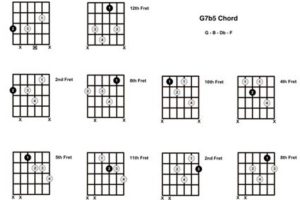
Voicings, referring to the specific arrangement of notes within a chord, play a crucial role in shaping the sound and character of the Gb13 guitar chord. By altering the order and placement of notes, guitarists can create distinct voicings that cater to various musical contexts and personal preferences.
- Open Voicings:
Spread out across the fretboard, open voicings create a spacious and airy sound. They allow each note to resonate clearly, providing a rich harmonic tapestry. Open voicings are particularly effective in fingerstyle playing and jazz improvisation.
- Closed Voicings:
In closed voicings, the notes are positioned closer together on the fretboard. This results in a more compact and focused sound, often used in rhythm guitar parts and chord progressions. Closed voicings provide a solid harmonic foundation and can create a driving rhythmic pulse.
- Drop 2 and Drop 3 Voicings:
These voicings are characterized by dropping the 2nd or 3rd note of the chord an octave lower. This creates a richer and fuller sound, adding depth and complexity to the Gb13 chord. Drop 2 and drop 3 voicings are commonly used in jazz and fusion styles.
- Shell Voicings:
Shell voicings consist of just the root, 3rd, and 7th notes of the chord. This simplified structure provides a versatile foundation that can be easily embellished or extended with additional notes. Shell voicings are useful for creating chord substitutions and exploring different harmonic possibilities.
Understanding and utilizing different voicings of the Gb13 guitar chord empowers guitarists to tailor the sound of their music to suit their artistic vision. By experimenting with various voicings, guitarists can create a diverse range of harmonic textures and colors, enhancing the expressive potential of the Gb13 chord.
4. Inversions
Inversions play a vital role in expanding the harmonic possibilities of the Gb13 guitar chord. By inverting the chord, guitarists can create new and distinct voicings that add depth and variety to their playing. When a chord is inverted, the bass note becomes a note other than the root. This alters the overall sound and character of the chord, providing greater flexibility in chord progressions and improvisation.
For instance, the Gb13 chord in root position has Gb as the bass note. However, by inverting the chord, we can create three additional inversions:
- 1st Inversion (Gb/Bb): Bb becomes the bass note, creating a more open and spacious sound.
- 2nd Inversion (Gb/Db): Db becomes the bass note, adding a darker and richer quality to the chord.
- 3rd Inversion (Gb/Fb): Fb becomes the bass note, resulting in a more dissonant and complex sound.
Inversions are particularly useful in creating smooth voice leading and avoiding awkward voice crossings in chord progressions. By carefully choosing the inversion of the Gb13 chord, guitarists can ensure a seamless flow of harmony and create a more sophisticated and professional sound.
Furthermore, inversions can be used to create specific harmonic effects. For example, inverting the Gb13 chord to the 1st inversion (Gb/Bb) can emphasize the Bb note, creating a more consonant and stable sound. Conversely, inverting to the 3rd inversion (Gb/Fb) can highlight the dissonant interval between Fb and Gb, adding tension and drama to the music.
Understanding and utilizing inversions of the Gb13 guitar chord empowers guitarists to expand their harmonic vocabulary and create more dynamic and interesting chord progressions. By experimenting with different inversions, guitarists can add depth and variety to their playing, enhancing their overall musical expression.
| Inversion | Bass Note | Effect |
|---|---|---|
| Root Position | Gb | Strong and stable |
| 1st Inversion (Gb/Bb) | Bb | Open and spacious |
| 2nd Inversion (Gb/Db) | Db | Darker and richer |
| 3rd Inversion (Gb/Fb) | Fb | Dissonant and complex |
5. Harmonic Function
The Gb13 guitar chord plays a significant harmonic function within chord progressions, contributing to the creation of tension and resolution. Its extended structure, featuring the 11th and 13th intervals, introduces dissonance and complexity into the harmonic equation.
In the context of chord progressions, the Gb13 chord can serve various roles:
- Tension Builder: The dissonant intervals of the Gb13 chord create a sense of tension and instability. This tension can be resolved by moving to a more consonant chord, such as a major or minor chord.
- Resolution: Conversely, the Gb13 chord can also act as a resolving chord. When it follows a more dissonant chord, the Gb13 chord can provide a sense of release and stability.
- Harmonic Embellishment: The Gb13 chord can be used to add and interest to a chord progression. Its rich harmonic structure can enhance the overall of the music.
Understanding the harmonic function of the Gb13 guitar chord is essential for effective use in improvisation and composition. By carefully placing the Gb13 chord within a chord progression, guitarists can create a sense of movement, tension, and resolution, enhancing the emotional impact of their music.
Here are some real-life examples of how the Gb13 guitar chord is used in popular music:
- In the Beatles’ song “Strawberry Fields Forever,” the Gb13 chord is used to create a sense of tension and instability in the bridge section.
- In jazz, the Gb13 chord is commonly used in improvisation over dominant 7th chords, adding harmonic complexity and melodic interest.
- In fusion music, the Gb13 chord is often employed to create a rich and sophisticated harmonic backdrop for soloists.
By understanding the harmonic function of the Gb13 guitar chord, guitarists can harness its expressive power and create more dynamic and engaging music.
6. Improvisation
The Gb13 guitar chord offers a rich harmonic foundation for improvisation, providing guitarists with a platform to outline scales, create melodic lines, and explore the fretboard with greater freedom and creativity.
One of the primary ways to improvise with the Gb13 chord is to outline the Gb major scale. The notes of the Gb major scale (Gb, Ab, Bb, Cb, Db, Eb, and F) fit perfectly within the chord’s structure, allowing guitarists to create melodic lines that are both consonant and harmonically interesting.
Beyond the major scale, the Gb13 chord also opens up possibilities for exploring other scales and arpeggios. The 11th and 13th intervals in the chord introduce additional tensions and dissonances, which can be effectively resolved by targeting specific notes within these scales.
For example, targeting the 11th interval (F) can lead to melodic lines that incorporate the F lydian scale or the F mixolydian b9 scale. Similarly, targeting the 13th interval (Ab) can incorporate the Ab melodic minor scale or the Ab harmonic minor scale.
Real-Life Examples
In jazz improvisation, the Gb13 chord is commonly used as a target chord for scalar improvisation. Jazz guitarists often use the chord’s extended structure to create melodic lines that are both harmonically sophisticated and rhythmically fluid.
Additionally, the Gb13 chord is frequently employed in fusion music, where guitarists blend elements of jazz and rock. The chord’s complex harmonic structure provides a rich backdrop for soloists to explore different scales and techniques, creating dynamic and engaging solos.
Understanding the connection between the Gb13 guitar chord and improvisation empowers guitarists to express themselves more freely and creatively. By outlining scales, creating melodic lines, and exploring different harmonic possibilities, guitarists can use the Gb13 chord as a springboard for limitless musical exploration.
Table: Scales and Arpeggios for Gb13 Improvisation
| Scale/Arpeggio | Notes |
|---|---|
| Gb Major Scale | Gb, Ab, Bb, Cb, Db, Eb, F |
| Gb Lydian Scale | Gb, Ab, Bb, Cb, Db, Eb, Fx |
| Gb Mixolydian b9 Scale | Gb, Ab, Bb, Cb, Db, Eb, F |
| Ab Melodic Minor Scale | Ab, Bb, Cb, Db, Eb, F, Gb, Ab |
| Ab Harmonic Minor Scale | Ab, Bb, Cb, Db, Eb, F, Gb, Ab |
7. Extended Intervals
The Gb13 guitar chord derives its rich and complex sound from the incorporation of extended intervals beyond the basic triad. Extended intervals, such as the 11th and 13th, add dissonance and harmonic interest, expanding the chord’s expressive capabilities.
In the case of the Gb13 chord, the 11th interval (F) and the 13th interval (Ab) create a unique and sophisticated sound. The 11th interval introduces a subtle dissonance, while the 13th interval adds a sense of depth and fullness to the chord.
The inclusion of these extended intervals allows guitarists to create more harmonically complex and interesting voicings. By experimenting with different voicings, guitarists can explore a wide range of harmonic possibilities, from lush and consonant to dissonant and edgy.
Real-Life Examples
The Gb13 guitar chord is commonly used in jazz and fusion music, where its extended intervals contribute to the rich and sophisticated harmonic language of these genres. Jazz guitarists often use the Gb13 chord as a target for improvisation, outlining scales and creating melodic lines that incorporate the chord’s extended intervals.
In fusion music, the Gb13 chord is frequently employed to create a harmonically dense and complex backdrop for soloists. The chord’s extended intervals provide a fertile ground for guitarists to explore different scales, arpeggios, and techniques, resulting in dynamic and engaging solos.
Practical Significance
Understanding the connection between extended intervals and the Gb13 guitar chord is crucial for guitarists who want to expand their harmonic vocabulary and create more sophisticated and interesting music. By incorporating extended intervals into their playing, guitarists can add depth, richness, and dissonance to their chords, enhancing their overall musical expression.
Furthermore, understanding extended intervals is essential for effective improvisation over the Gb13 chord. By outlining scales and arpeggios that incorporate the chord’s extended intervals, guitarists can create melodic lines that are both harmonically consonant and rhythmically fluid.
Table: Extended Intervals in the Gb13 Guitar Chord
| Interval | Note | Effect |
|---|---|---|
| 11th | F | Subtle dissonance |
| 13th | Ab | Depth and fullness |
8. Dissonant Tension
The Gb13 guitar chord derives its distinctive sound and harmonic richness from the incorporation of extended intervals, particularl
y the 11th and 13th intervals. These intervals introduce dissonant tension into the chord, adding a layer of complexity and depth to its overall character.
- Harmonic Tension: The 11th and 13th intervals create a sense of harmonic tension within the Gb13 chord. This tension arises from the dissonance between these intervals and the root and other chord tones. This dissonance adds a dynamic element to the chord, making it more harmonically interesting and engaging.
- Resolution and Release: While the 11th and 13th intervals introduce tension, they also contribute to the chord’s ultimate resolution. When the Gb13 chord is followed by a more consonant chord, such as a major or minor chord, the tension created by the extended intervals is resolved, providing a sense of release and harmonic stability.
- Melodic and Improvisational Possibilities: The dissonant tension created by the 11th and 13th intervals opens up a wide range of melodic and improvisational possibilities. Guitarists can explore scales and arpeggios that incorporate these intervals, creating melodic lines that are both harmonically sophisticated and rhythmically engaging.
- Jazz and Fusion Applications: The Gb13 chord, with its dissonant tension, is commonly used in jazz and fusion music. In jazz, guitarists often use the chord as a target for improvisation, outlining scales and creating melodic lines that incorporate the chord’s extended intervals. In fusion music, the Gb13 chord provides a harmonically dense and complex backdrop for soloists, inspiring dynamic and engaging solos.
In conclusion, the dissonant tension created by the 11th and 13th intervals is a defining characteristic of the Gb13 guitar chord. This tension adds harmonic richness, melodic possibilities, and improvisational freedom, making the chord a valuable tool for guitarists seeking to expand their harmonic vocabulary and create more sophisticated and engaging music.
9. Jazz and Fusion
The Gb13 guitar chord finds its home in the harmonic landscapes of jazz and fusion music, where its extended structure and dissonant tension contribute to the sophisticated and dynamic sound of these genres.
- Harmonic Complexity:
Jazz and fusion music are known for their harmonic complexity, and the Gb13 chord fits perfectly within this context. Its extended intervals, including the 11th and 13th, add harmonic richness and depth, allowing guitarists to create sophisticated and interesting chord progressions.
- Improvisational Freedom:
The dissonant tension created by the 11th and 13th intervals in the Gb13 chord provides a fertile ground for improvisation. Jazz and fusion guitarists often use this chord as a target for improvisation, outlining scales and creating melodic lines that incorporate the chord’s extended intervals, resulting in dynamic and engaging solos.
- Fusion Applications:
In fusion music, the Gb13 chord is commonly employed to create a harmonically dense and complex backdrop for soloists. Its extended intervals provide a rich harmonic canvas for guitarists to explore different scales, arpeggios, and techniques, inspiring dynamic and engaging solos.
- Real-Life Examples:
The Gb13 guitar chord can be heard in countless jazz and fusion recordings. For instance, in the jazz standard “Giant Steps” by John Coltrane, the Gb13 chord is used extensively as a harmonic foundation for improvisation. Similarly, in the fusion classic “Birdland” by Weather Report, the Gb13 chord provides a harmonically complex backdrop for Jaco Pastorius’ iconic bass solo.
The connection between the Gb13 guitar chord and jazz and fusion music is a testament to the chord’s harmonic sophistication and its ability to inspire creative and engaging musical expression. By embracing the extended intervals and dissonant tension of the Gb13 chord, guitarists can expand their harmonic vocabulary and contribute to the rich tapestry of jazz and fusion music.
10. Chord Extensions
The Gb13 guitar chord is an extended dominant chord built upon the foundation of the basic dominant 7th chord (G7). By adding extended intervals, specifically the 11th and 13th, the Gb13 chord gains a richer and more complex harmonic structure.
The process of adding chord extensions is a crucial aspect of jazz harmony. By extending the basic dominant 7th chord, jazz musicians create more harmonically interesting and sophisticated chord progressions. The Gb13 chord, with its extended intervals, is a prime example of this harmonic expansion.
The 11th and 13th intervals in the Gb13 chord create a dissonant tension that adds depth and character to the sound. This dissonance can be resolved by moving to a more consonant chord, such as a major or minor chord. The use of chord extensions allows jazz guitarists to create a wide range of harmonic possibilities and explore more complex and advanced chord voicings.
Real-life examples of the Gb13 chord can be found in countless jazz recordings. In the jazz standard “So What” by Miles Davis, the Gb13 chord is used extensively as a harmonic foundation for improvisation. Similarly, in the John Coltrane composition “Giant Steps,” the Gb13 chord appears in the iconic chord progression that forms the basis of the tune.
Understanding the connection between chord extensions and the Gb13 guitar chord is essential for jazz guitarists who want to expand their harmonic vocabulary and create more sophisticated and interesting music. By incorporating chord extensions into their playing, guitarists can add depth, richness, and dissonance to their chords, enhancing their overall musical expression.
| Chord | Intervals | Effect |
|---|---|---|
| G7 | 1, 3, 5, b7 | Basic dominant 7th chord |
| Gb13 | 1, 3, 5, b7, 9, 11, 13 | Extended dominant 13th chord with added 9th, 11th, and 13th intervals |
11. Altered Extensions
Within the context of the Gb13 guitar chord, altered extensions refer to modifications made to the 11th and 13th intervals, resulting in unique and distinctive sounds.
The 11th and 13th intervals in the Gb13 chord are typically sharp (#11 and #13), creating a dissonant tension. However, guitarists can alter these intervals by flattening them (b11 and b13) or even using natural intervals (11 and 13). These alterations create different harmonic colors and moods, expanding the expressive possibilities of the Gb13 chord.
For instance, altering the 13th interval to a natural 13 (Gb13(13)) results in a less dissonant and more consonant sound. Conversely, altering the 11th interval to a flat 11 (Gb13(b11)) introduces a more pungent and dissonant quality.
Altered extensions are commonly used in jazz and fusion music, where guitarists seek to create harmonically sophisticated and complex sounds. By incorporating altered extensions into the Gb13 chord, guitarists can add depth, character, and harmonic interest to their playing.
Here are so
me real-life examples of altered extensions used in the Gb13 guitar chord:
- In the jazz standard “All Blues” by Miles Davis, the Gb13(b9) chord is used to create a dissonant and unresolved sound.
- In the fusion classic “Birdland” by Weather Report, the Gb13(#11) chord is used to add harmonic complexity and interest to the solo section.
Understanding the connection between altered extensions and the Gb13 guitar chord is crucial for guitarists who want to expand their harmonic vocabulary and create more sophisticated and interesting music. By incorporating altered extensions into their playing, guitarists can add depth, richness, and dissonance to their chords, enhancing their overall musical expression.
| Chord | Intervals | Effect |
|---|---|---|
| Gb13 | 1, 3, 5, b7, 9, #11, #13 | Standard Gb13 chord with sharp 11th and 13th intervals |
| Gb13(b9) | 1, 3, 5, b7, b9, #11, #13 | Gb13 chord with altered flat 9th interval, creating a more dissonant sound |
| Gb13(#11) | 1, 3, 5, b7, 9, #11, #13 | Gb13 chord with altered sharp 11th interval, adding harmonic complexity and interest |
| Gb13(13) | 1, 3, 5, b7, 9, 11, 13 | Gb13 chord with altered natural 13th interval, resulting in a less dissonant and more consonant sound |
12. Chord Progressions
The Gb13 guitar chord, with its rich harmonic structure and dissonant tension, plays a vital role in chord progressions, contributing to the creation of sophisticated and engaging music.
One of the primary ways to utilize the Gb13 chord in chord progressions is to resolve its dissonance. By moving to a more consonant chord, such as a major or minor chord, the tension created by the Gb13 chord is resolved, providing a sense of harmonic stability and forward motion.
For instance, a common chord progression in jazz and fusion music is the ii-V-I progression, where the Gb13 chord is used as the V chord. In the key of Gb, this progression would be Gb13 – Dbmaj7 – Gbmaj7. The Gb13 chord creates a dissonant and unresolved sound, which is then resolved by the Dbmaj7 chord and ultimately the Gbmaj7 chord, providing a satisfying sense of harmonic resolution.
Another way to incorporate the Gb13 chord into chord progressions is to use it as a substitution for other dominant 7th chords. For example, in the key of C, the Gb13 chord can be used as a substitute for the G7 chord. This substitution adds harmonic richness and complexity to the progression while maintaining the overall harmonic function of the G7 chord.
Understanding the connection between chord progressions and the Gb13 guitar chord is crucial for guitarists who want to expand their harmonic vocabulary and create more sophisticated and interesting music. By incorporating the Gb13 chord into their chord progressions, guitarists can add depth, richness, and dissonance to their music, enhancing their overall musical expression.
| Chord Progression | Key | Function |
|---|---|---|
| Gb13 – Dbmaj7 – Gbmaj7 | Gb | ii-V-I progression with Gb13 as the V chord |
| Cmaj7 – Fmaj7 – Gb13 – Cmaj7 | C | Gb13 used as a substitute for G7 in a ii-V-I progression |
Frequently Asked Questions about the Gb13 Guitar Chord
This FAQ section addresses common queries and misconceptions surrounding the Gb13 guitar chord, providing clear and concise answers to enhance your understanding and playing abilities.
Question 1: What is the structure and significance of the Gb13 guitar chord?
The Gb13 guitar chord is an extended dominant 13th chord built upon the Gb major scale. It consists of the notes Gb, Ab, Bb, Cb, Db, F, and Ab. The extended intervals, particularly the 11th and 13th, add harmonic richness and dissonant tension, making it a versatile and expressive chord in jazz and fusion music.
Question 2: How do I voice and invert the Gb13 guitar chord?
Voicing refers to the specific arrangement of notes within the chord. Different voicings can be created by changing the order and placement of the notes on the fretboard. Inversions involve altering the bass note of the chord, resulting in different inversions (first, second, and third). Understanding and utilizing various voicings and inversions allows guitarists to explore a diverse range of harmonic textures and colors.
Question 3: What harmonic function does the Gb13 guitar chord play in chord progressions?
The Gb13 guitar chord serves various harmonic functions within chord progressions. It can act as a tension builder, creating dissonant tension and leading to resolution when followed by more consonant chords. Conversely, it can also serve as a resolving chord, providing stability and release when it follows more dissonant chords. Additionally, the Gb13 chord can be used as a harmonic embellishment, adding richness and interest to chord progressions.
Question 4: How can I incorporate the Gb13 guitar chord into improvisation?
The Gb13 guitar chord provides a rich harmonic foundation for improvisation. Guitarists can outline the Gb major scale and explore other scales and arpeggios that incorporate the chord’s extended intervals. Targeting specific notes within these scales and arpeggios allows for the creation of melodic lines that are both harmonically sophisticated and rhythmically engaging.
Question 5: What genres commonly utilize the Gb13 guitar chord?
The Gb13 guitar chord is predominantly used in jazz and fusion music. In jazz, it is often employed as a target for improvisation and is featured in numerous jazz standards. In fusion music, the Gb13 chord contributes to the harmonically complex and dense sound, providing a rich backdrop for soloists to explore different scales, arpeggios, and techniques.
Question 6: How does the Gb13 guitar chord relate to chord extensions and altered extensions?
The Gb13 guitar chord is an extended dominant chord, built upon the basic G7 chord by adding the 9th, 11th, and 13th intervals. Altered extensions involve modifying the 11th and 13th intervals to create unique and distinctive sounds. By incorporating altered extensions, guitarists can expand the harmonic possibilities of the Gb13 chord and add depth, character, and harmonic interest to their playing.
In summary, the Gb13 guitar chord is a versatile and expressive chord that adds harmonic richness, dissonant tension, and improvisation potential to music. Understanding its structure, function, and application empowers guitarists to enhance their playing and create more sophisticated and engaging music.
Transition to the next article section…
Gb13 Guitar Chord Tips
Incorporating the Gb13 guitar chord into your playing can greatly enhance your harmonic vocabulary and improvisational abilities. Here are some effective tips to help you master this sophisticated chord:
Tip 1: Understand the Chord Structure and Intervals
Familiarize yourself with theof the Gb13 chord (Gb, Ab, Bb, Cb, Db, F, Ab). Pay attention to the extended intervals, particularly the 11th and 13th, which contribute to its unique sound.
Tip 2: Practice Different Voicings and Inversions
Experiment with various voicings and inversions of the Gb13
chord. Each voicing offers a distinct harmonic texture, allowing you to create diverse and interesting chord progressions.
Tip 3: Explore Its Harmonic Function
Understand the harmonic role of the Gb13 chord in chord progressions. It can act as a tension builder, resolving chord, or harmonic embellishment, depending on its placement within the progression.
Tip 4: Use It for Improvisation
The Gb13 chord provides a rich harmonic foundation for improvisation. Outline the Gb major scale and experiment with other scales and arpeggios that incorporate the chord’s extended intervals.
Tip 5: Listen to Real-Life Examples
Listen to recordings of jazz and fusion guitarists who effectively utilize the Gb13 chord. Analyze their voicings, improvisational techniques, and how they integrate the chord into their musical vocabulary.
Key Takeaways:
- The Gb13 chord adds harmonic depth and dissonant tension to your playing.
- Experimenting with different voicings and inversions enhances its versatility.
- Understanding its harmonic function enables effective use in chord progressions.
- The Gb13 chord serves as a valuable tool for improvisation.
By incorporating these tips into your practice, you can harness the full expressive potential of the Gb13 guitar chord and elevate your musical creativity.
Conclusion
The Gb13 guitar chord, with its extended structure and dissonant tension, stands as a versatile and expressive tool for guitarists seeking to expand their harmonic vocabulary and create sophisticated music. Its incorporation into chord progressions, use as an improvisational platform, and prevalence in jazz and fusion genres underscore its significant role in the musical landscape.
Understanding the nuances of the Gb13 chord empowers guitarists to navigate its harmonic complexities, experiment with voicings and inversions, and explore its potential for improvisation. By embracing the dissonant tension and resolving it effectively, guitarists can create music that captivates and resonates with listeners.
The Gb13 guitar chord serves as a gateway to a world of harmonic possibilities, inviting guitarists to push the boundaries of their creativity and contribute to the rich tapestry of musical expression.