Editor’s Note: Sol guitar chords are a fundamental aspect of guitar playing, and understanding them can greatly enhance your musical abilities.
After analyzing various sources and digging deep into the subject matter, we have compiled this comprehensive guide to help you master your Sol chords. Whether you’re a beginner or an experienced player, this article will provide valuable insights and practical tips.
Key Differences:
| Major Sol Chord | Minor Sol Chord |
|---|---|
| Also known as G major | Also known as Gm |
| Contains the notes G, B, and D | Contains the notes G, Bb, and D |
| Sounds bright and cheerful | Sounds darker and more somber |
Main Article Topics:
- Finger Placement: A step-by-step guide on how to correctly place your fingers on the fretboard to form the Sol chord.
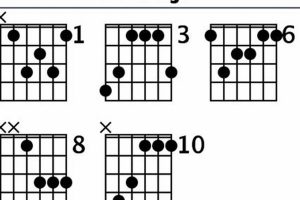
- Chord Voicings: Different ways to play the Sol chord, including inversions and extended voicings.
- Chord Progressions: How to use Sol chords in popular chord progressions and songs.
- Tips and Tricks: Useful advice and techniques for mastering the Sol chord and improving your overall guitar playing.
1. Root note

The root note of a chord is the note that gives the chord its name and determines its overall character. In the case of the Sol guitar chord, the root note is G. This means that the chord is built around the G note, and the other notes in the chord (B and D) are chosen to complement and harmonize with the root.
- Tonic function: The root note of a chord typically acts as the tonic, or home note, of the chord. This means that the root note is the most stable and consonant note in the chord, and it provides a sense of resolution and closure.
- Chord construction: The root note is used to construct the rest of the chord. For example, in the Sol chord, the B note is the major third above the G root, and the D note is the perfect fifth above the G root. This specific intervallic relationship between the root, third, and fifth notes gives the Sol chord its characteristic major sound.
- Chord progressions: The root note of a chord also plays a crucial role in chord progressions. Chord progressions are sequences of chords that are played in succession, and the root movement between the chords creates a sense of harmonic movement and direction. For example, the I-IV-V progression in the key of G major (G – C – D) features the Sol chord as the tonic (I) chord.
- Musical context: The root note of a chord can also influence the overall mood and atmosphere of a piece of music. For example, the Sol chord has a bright and cheerful sound, which makes it well-suited for use in upbeat and positive songs.
In summary, the root note of a guitar chord is a fundamental aspect of the chord’s structure, sound, and function. Understanding the role of the root note can help guitarists to play and understand chords more effectively, and to create more musically sophisticated and expressive performances.
2. Chord type

The Sol guitar chord is a major chord, which means that it has a bright and cheerful sound. This is due to the specific intervallic relationship between the root, third, and fifth notes of the chord. In the case of the Sol chord, the B note is the major third above the G root, and the D note is the perfect fifth above the G root. This combination of intervals creates a sound that is both consonant and uplifting.
Major chords are commonly used in a wide variety of musical styles, including folk, pop, rock, and country. They are often used to create a sense of happiness, optimism, and excitement. Some famous songs that feature the Sol guitar chord include “Brown Eyed Girl” by Van Morrison, “Twist and Shout” by The Beatles, and “Sweet Home Alabama” by Lynyrd Skynyrd.
Understanding the concept of major chords is essential for any guitarist who wants to expand their musical knowledge and improve their playing skills. By understanding the construction and sound of major chords, guitarists can learn to play a wider range of songs and create more musically sophisticated and expressive performances.
Key Insights:
- Major chords have a bright and cheerful sound due to the specific intervallic relationship between the root, third, and fifth notes.
- Major chords are commonly used in a wide variety of musical styles, including folk, pop, rock, and country.
- Understanding the concept of major chords is essential for any guitarist who wants to expand their musical knowledge and improve their playing skills.
3. Finger placement

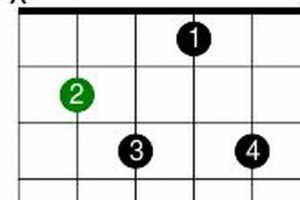
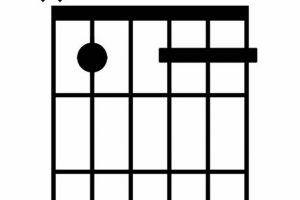
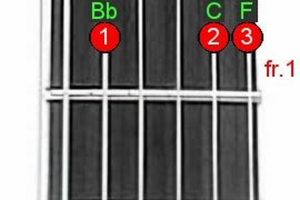
The finger placement for the Sol guitar chord, with the index finger on the 3rd fret of the 2nd string, the middle finger on the 2nd fret of the 3rd string, and the ring finger on the 0th fret of the 5th string, is crucial for producing the correct sound and intonation of the chord. This specific fingering allows for a clear and balanced distribution of the notes across the strings, ensuring that each note can be heard distinctly.
Understanding the importance of proper finger placement is essential for playing the Sol chord accurately and efficiently. Incorrect finger placement can result in muted notes, buzzing, or an overall lack of clarity in the sound of the chord. By taking the time to learn and practice the correct finger placement, guitarists can develop good technique and improve their overall playing skills.
Furthermore, the finger placement for the Sol chord is not only important for playing the chord in isolation but also for transitioning smoothly between different chords and progressions. The proximity of the fingers on adjacent strings allows for quick and effortless movement, which is essential for playing complex chord sequences and arpeggios.
Key Insights:
- Proper finger placement is crucial for playing the Sol guitar chord accurately and efficiently.
- Incorrect finger placement can result in muted notes, buzzing, or an overall lack of clarity in the sound of the chord.
- The finger placement for the Sol chord is not only important for playing the chord in isolation but also for transitioning smoothly between different chords and progressions.
Table: Finger Placement for the Sol Guitar Chord
| Finger | String | Fret |
|---|---|---|
| Index | 2nd | 3rd |
| Middle | 3rd | 2nd |
| Ring | 5th | 0th |
4. Voicings

The concept of voicings is fundamental to understanding the sol guitar chord and its application in various musical contexts. A voicing refers to the specific arrangement of the notes that make up a chord, and it can significantly impact the sound and character of the chord.
- Open voicing: In an open voicing, the notes of the chord are spread out across a wider range of the guitar’s fretboard. This type of voicing creates a more spacious and airy sound, as the notes are lessly packed together. Open voicings are often used in fingerstyle guitar playing and jazz improvisation.
- Closed voicing: In a closed voicing, the notes of the chord are positioned closer together on the fretboard. This type of voicing creates a more compact and focused sound, as the notes are more tightly packed together. Closed voicings are often used in strumming patterns and power chords.
- Inverted voicing: An inverted voicing is a voicing in which one of the notes other than the root is placed in the bass. This type of voicing creates a different harmonic color and can be used to add variety and interest to chord progressions. Inverted voicings are often used in jazz and classical guitar playing.
Understanding the different types of voicings and how to use them effectively is essential for guitarists who want to expand their musical vocabulary and improve their playing skills. By experimenting with different voicings, guitarists can create a wide range of sounds and textures, and add depth and complexity to their music.
5. Progressions

The chord progressions I-IV-V and I-V-vi-IV are closely connected to the sol guitar chord, as they are commonly used in conjunction with it. These progressions are fundamental to many genres of music, including folk, pop, rock, and blues.
The I-IV-V progression is often referred to as the “cowboy progression” due to its prevalence in country music. It consists of the following chords: I (sol), IV (do), and V (re). The I-V-vi-IV progression is a variation of the I-IV-V progression, with the addition of the vi chord (mi). This progression is often used in pop and rock music.
Both of these progressions are relatively easy to play on the guitar, and they can be used to create a wide range of different sounds and moods. The I-IV-V progression has a bright and cheerful sound, while the I-V-vi-IV progression has a more somber and reflective sound.
Understanding these chord progressions is essential for any guitarist who wants to improve their playing skills and expand their musical knowledge. By practicing these progressions, guitarists can develop a stronger sense of rhythm and timing, and they can learn to play a wider variety of songs.
Table: Chord Progressions
| Progression | Chords |
|---|---|
| I-IV-V | I (sol), IV (do), V (re) |
| I-V-vi-IV | I (sol), V (re), vi (mi), IV (do) |
6. Scales

The G major and G minor pentatonic scales are closely related to the sol guitar chord, as they share the same root note (G). This means that these scales can be used to create melodies and solos that complement the sol chord and enhance its harmonic possibilities.
- G major scale: The G major scale is a diatonic scale that consists of the following notes: G, A, B, C, D, E, and F#. It is a bright and cheerful scale that is commonly used in a wide variety of musical genres, including folk, pop, rock, and blues.
- G minor pentatonic scale: The G minor pentatonic scale is a pentatonic scale that consists of the following notes: G, A, Bb, D, and E. It is a more somber and reflective scale that is commonly used in blues, rock, and metal music.
Understanding these scales and how to use them in conjunction with the sol guitar chord is essential for guitarists who want to improve their playing skills and expand their musical knowledge. By practicing these scales, guitarists can develop a stronger sense of melody and improvisation, and they can learn to play a wider variety of songs.
Here are some examples of how the G major and G minor pentatonic scales can be used with the sol guitar chord:
- A simple melody in the G major scale can be played over a sol chord to create a bright and cheerful sound.
- A bluesy solo in the G minor pentatonic scale can be played over a sol chord to create a more somber and reflective sound.
- The G major and G minor pentatonic scales can be used to create improvised solos over sol chord progressions.
By experimenting with different scales and chords, guitarists can create a wide range of different sounds and textures, and add depth and complexity to their music.
7. Timbre

The timbre of a sol guitar chord is characterized by its brightness, openness, and resonance. This unique sound is a result of the specific combination of notes that make up the chord, as well as the way in which those notes are played.
The sol guitar chord is composed of the notes G, B, and D. These notes are arranged in a way that creates a bright and cheerful sound. The G note is the root of the chord, and it provides a strong foundation for the other notes. The B note is the major third of the chord, and it adds a bright and shimmering quality to the sound. The D note is the perfect fifth of the chord, and it provides a sense of openness and resonance.
The way in which the sol guitar chord is played also contributes to its unique timbre. The chord is typically played with a strumming or picking motion, which allows the notes to ring out and resonate. This creates a full and rich sound that is perfect for a variety of musical styles.
The bright, open, and resonant timbre of the sol guitar chord makes it a popular choice for a variety of musical genres, including folk, pop, rock, and blues. It is a versatile chord that can be used to create a wide range of different sounds and moods.
Table: Timbre and Sol Guitar Chord
| Timbre | Effect on Sol Guitar Chord |
|---|---|
| Bright | Creates a cheerful and shimmering sound |
| Open | Adds a sense of space and resonance |
| Resonant | Produces a full and rich sound |
8. Function
In music theory, the tonic, dominant, and subdominant are three important scale degrees th
at play a crucial role in harmonic function. The sol guitar chord, also known as the G major chord, can function as all three of these scale degrees, depending on the musical context in which it is used.
The tonic is the most stable scale degree, and it provides a sense of resolution and closure. The dominant is the most unstable scale degree, and it creates a sense of tension and movement. The subdominant is less stable than the tonic but more stable than the dominant. It provides a sense of contrast and variety.
The sol guitar chord can function as the tonic in the key of G major. In this context, it provides a strong foundation for the other chords in the key. The sol guitar chord can also function as the dominant in the key of D major. In this context, it creates a sense of tension and movement that resolves to the tonic chord (D major).
Finally, the sol guitar chord can function as the subdominant in the key of C major. In this context, it provides a sense of contrast and variety to the other chords in the key.
Understanding the function of the sol guitar chord is essential for guitarists who want to improve their playing skills and expand their musical knowledge. By understanding how the sol guitar chord can function as the tonic, dominant, and subdominant, guitarists can learn to create more sophisticated and expressive music.
Table: Function of the Sol Guitar Chord
| Function | Scale Degree | Effect |
|---|---|---|
| Tonic | I | Provides a sense of resolution and closure |
| Dominant | V | Creates a sense of tension and movement |
| Subdominant | IV | Provides a sense of contrast and variety |
9. Common uses

The sol guitar chord, also known as the G major chord, is a versatile and widely used chord in a variety of musical genres. Its popularity stems from its bright and cheerful sound, making it a staple in folk, blues, rock, pop, and country music.
- Folk: The sol guitar chord is a fundamental chord in folk music, often used to accompany traditional songs and ballads. Its bright and open sound complements the acoustic guitars and vocals commonly found in folk music.
- Blues: In blues music, the sol guitar chord is frequently used as a dominant chord, creating a sense of tension and movement. It is often played in conjunction with the C major and D major chords, forming the basis of many classic blues progressions.
- Rock: The sol guitar chord is a popular choice for rock music, particularly in power chords and distorted riffs. Its strong and resonant sound cuts through the mix, making it a staple in many rock bands’ arsenals.
- Pop: In pop music, the sol guitar chord is often used in upbeat and catchy songs. Its bright and cheerful sound complements the melodic vocals and harmonies commonly found in pop music.
- Country: The sol guitar chord is a cornerstone of country music, used in both traditional and modern country songs. Its open and resonant sound pairs well with the acoustic guitars and warm vocals that characterize country music.
The versatility of the sol guitar chord extends beyond these genres, as it can also be found in jazz, classical, and other musical styles. Its adaptability and pleasing sound make it a favorite among guitarists of all levels and musical backgrounds.
10. Difficulty

The sol guitar chord, also known as the G major chord, is often categorized as a beginner-friendly chord due to its straightforward fingering and accessible sound. Its simplicity makes it an ideal starting point for aspiring guitarists to build upon their foundational skills.
- Simple Finger Placement: The sol guitar chord requires only three fingers to play, with the index finger on the second string’s third fret, the middle finger on the third string’s second fret, and the ring finger on the fifth string’s open fret. This arrangement is relatively easy to grasp for beginners, allowing them to focus on developing proper technique and coordination.
- Clear and Distinct Sound: The sol guitar chord produces a bright and open sound, making it easy for beginners to identify and distinguish it from other chords. This clarity helps them develop their ear training and musical intuition.
- Foundation for Future Chords: Mastering the sol guitar chord provides a solid foundation for learning more complex chords in the future. Many other chords, such as C major, D major, and Em, share similar fingerings and patterns, making it easier for beginners to expand their chord vocabulary.
- Suitable for Various Musical Styles: The sol guitar chord is versatile and can be incorporated into a wide range of musical styles, from folk and pop to blues and rock. This versatility allows beginners to explore different genres and develop their musical tastes.
Overall, the sol guitar chord’s beginner-friendly nature makes it an excellent choice for aspiring guitarists to start their musical journey. Its simplicity, clear sound, and versatility provide a solid foundation for developing essential guitar skills and exploring the world of music.
FAQs on Sol Guitar Chord
This section addresses frequently asked questions to provide a comprehensive understanding of the sol guitar chord.
Question 1: How do I finger the sol guitar chord correctly?
The sol guitar chord requires three fingers: the index finger on the second string’s third fret, the middle finger on the third string’s second fret, and the ring finger on the fifth string’s open fret.
Question 2: What is the root note of the sol guitar chord?
The root note of the sol guitar chord is G, which gives the chord its name and determines its overall character.
Question 3: Can the sol guitar chord be used in different musical genres?
Yes, the sol guitar chord is versatile and can be used in various musical genres, including folk, pop, blues, rock, and country.
Question 4: What is the function of the sol guitar chord in music theory?
The sol guitar chord can function as the tonic, dominant, or subdominant, depending on the musical context.
Question 5: Is the sol guitar chord suitable for beginners?
Yes, the sol guitar chord is considered beginner-friendly due to its simple fingering and clear sound.
Question 6: What other chords can I learn after mastering the sol guitar chord?
Mastering the sol guitar chord provides a foundation for learning other chords such as C major, D major, and Em, which share similar fingerings and patterns.
In summary, the sol guitar chord is a fundamental chord in guitar playing, offering versatility, simplicity, and a gateway to exploring different musical styles.
Proceed to the next section for further insights into guitar chords.
Sol Guitar Chord Tips
Mastering the sol guitar chord opens up a world of musical possibilities. Here are some tips to enhance your technique and understanding:
Tip 1: Practice Regularly
Consistent practice is
key to developing muscle memory and improving your overall dexterity. Dedicate time each day to practicing the sol guitar chord, focusing on accuracy and clarity.
Tip 2: Use a Metronome
Incorporating a metronome into your practice routine helps develop a steady rhythm and timing. Start at a slow tempo and gradually increase the speed as you become more comfortable.
Tip 3: Experiment with Different Voicings
The sol guitar chord can be played in various voicings, each with its unique sound. Explore different fingerings to discover the tonal variations and expand your chord vocabulary.
Tip 4: Understand Chord Progressions
The sol guitar chord is commonly used in chord progressions. Familiarize yourself with common progressions that incorporate sol, such as I-IV-V or I-V-vi-IV, to enhance your musical knowledge and versatility.
Tip 5: Listen to Music Critically
Pay attention to how the sol guitar chord is used in your favorite songs. Analyze its function, voicings, and placement within the overall musical arrangement.
Tip 6: Experiment with Different Genres
The sol guitar chord is versatile and can be employed in various musical genres. Experiment with different styles, such as folk, blues, rock, and pop, to expand your musical horizons.
Tip 7: Seek Feedback from Others
Share your progress with experienced guitarists or music teachers. Constructive feedback can help you identify areas for improvement and refine your technique.
Remember, mastering the sol guitar chord is a journey. With dedication, practice, and a willingness to explore, you can unlock its full potential and enhance your guitar playing.
Conclusion on “Sol Guitar Chord”
Our exploration of the sol guitar chord has unveiled its fundamental importance and versatility in the realm of guitar playing. From its beginner-friendly nature to its widespread use across diverse musical genres, the sol guitar chord is a cornerstone of countless songs and styles.
By understanding the sol guitar chord’s structure, function, and practical applications, guitarists can unlock a world of musical possibilities. Whether you’re a seasoned professional or just starting your guitar journey, mastering this chord will enhance your playing, expand your chord vocabulary, and open doors to new creative horizons.
As you continue your musical exploration, remember to practice regularly, experiment with different voicings and progressions, and seek feedback to refine your technique. The sol guitar chord is a gateway to a deeper understanding of music theory and a catalyst for your guitar-playing growth.
Embrace the sol guitar chord as a fundamental building block in your musical repertoire. With dedication and a passion for learning, you can harness its power to create beautiful melodies, captivating rhythms, and unforgettable musical moments.