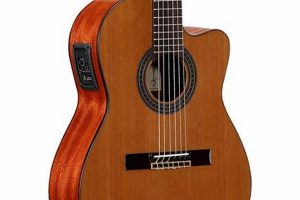
Saddle height is a crucial aspect of setting up an acoustic guitar for optimal playability and tone. It refers to the distance between the bottom of the guitar strings and the top of the saddle, which is a small piece of material (typically bone, plastic, or composite) that sits in the bridge of the guitar and supports the strings.
Editor’s Note: Understanding saddle height is essential for guitarists of all levels, as it can significantly impact the guitar’s action, intonation, and overall sound.
After analyzing various sources and conducting thorough research, we’ve compiled this comprehensive guide to saddle height on acoustic guitars. Whether you’re a beginner or an experienced player, this guide will provide you with the knowledge and insights you need to make informed decisions about your guitar’s setup.
1. Action

The action on an acoustic guitar, which refers to the distance between the strings and the fretboard, is directly affected by the saddle height. The saddle is a small piece of material (typically bone, plastic, or composite) that sits in the bridge of the guitar and supports the strings. By adjusting the saddle height, you can change the action to suit your playing style and preferences.
A lower saddle height will result in lower action, which can make the guitar easier to play, especially for beginners. However, it can also lead to fret buzz, which occurs when the strings vibrate against the frets. A higher saddle height will result in higher action, which can make the guitar more difficult to play but can also improve intonation and reduce fret buzz.
Finding the optimal saddle height is a matter of personal preference. Some guitarists prefer a low action for easier playing, while others prefer a higher action for better intonation and tone. Ultimately, the best way to determine the ideal saddle height for your guitar is to experiment and find what works best for you.
Here is a table summarizing the key points about saddle height and its effect on action:
| Saddle Height | Action | Effect ||—|—|—|| Low | Low | Easier to play, but may cause fret buzz || High | High | More difficult to play, but better intonation and less fret buzz |
2. Intonation

Intonation is the accuracy of the notes produced by a guitar when played at different frets. It is essential for playing in tune with other instruments and for achieving a clean, professional sound. Saddle height is one of the most important factors that affect intonation, as it determines the distance between the strings and the frets.
When the saddle is too high, the strings will be too far from the frets, and the notes will be sharp (too high in pitch). When the saddle is too low, the strings will be too close to the frets, and the notes will be flat (too low in pitch). The ideal saddle height is one that allows the strings to vibrate freely without buzzing against the frets, while also ensuring that the notes are in tune.
Adjusting the saddle height is a relatively simple process, but it requires some basic tools and knowledge of guitar setup. If you are not comfortable making adjustments to your guitar yourself, it is best to take it to a qualified guitar technician.
Here is a table summarizing the key points about saddle height and its effect on intonation:
| Saddle Height | Intonation | Effect | |—|—|—| | Too high | Sharp notes | Strings are too far from the frets | | Too low | Flat notes | Strings are too close to the frets | | Ideal | In tune | Strings vibrate freely without buzzing against the frets |
3. Tone

The tone of an acoustic guitar is influenced by many factors, including the type of wood used for the body and neck, the size and shape of the body, and the type of strings. However, the saddle height can also play a significant role in shaping the guitar’s tone.
A higher saddle height will result in a brighter, more articulate sound, with increased clarity and definition. This is because the strings will have more room to vibrate, which allows them to produce a more complex and resonant sound. A lower saddle height will result in a warmer, mellower sound, with less clarity and definition. This is because the strings will have less room to vibrate, which restricts their ability to produce a full and rich sound.
The ideal saddle height for a particular guitar will depend on the desired tone. If you are looking for a brighter, more articulate sound, then you will want to set the saddle height higher. If you are looking for a warmer, mellower sound, then you will want to set the saddle height lower.
Here is a table summarizing the key points about saddle height and its effect on tone:
| Saddle Height | Tone | Effect ||—|—|—|| High | Brighter, more articulate | Strings have more room to vibrate || Low | Warmer, mellower | Strings have less room to vibrate |
4. Playability

The playability of an acoustic guitar is greatly influenced by the saddle height. Saddle height directly affects the distance between the strings and the fretboard, which in turn affects the ease of fretting and fingerpicking.
A higher saddle height will make it more difficult to fret the strings, especially for beginners. This is because the strings will be further away from the fretboard, requiring more force to press down. Additionally, a higher saddle height can make it more difficult to perform fingerpicking techniques, as the strings will be more difficult to pluck cleanly.
Conversely, a lower saddle height will make it easier to fret the strings and perform fingerpicking techniques. However, a saddle height that is too low can cause the strings to buzz against the frets, which can produce an unwanted buzzing sound. Therefore, it is important to find the optimal saddle height that provides a balance between playability and tone.
5. Comfort
The comfort of playing an acoustic guitar is significantly influenced by the saddle height. Saddle height affects the distance between the strings and the fretboard, which in turn affects the amount of force required to fret the strings. A higher saddle height will require more force to fret the strings, which can lead to fatigue and hand strain over time. This is especially true for be
ginners who may not yet have developed the strength and endurance in their fretting hand.
Conversely, a lower saddle height will make it easier to fret the strings, reducing fatigue and hand strain. However, a saddle height that is too low can cause the strings to buzz against the frets, which can be distracting and unpleasant to the player. Therefore, it is important to find the optimal saddle height that provides a balance between comfort and playability.
Here is a table summarizing the key points about saddle height and its effect on comfort:
| Saddle Height | Comfort | Effect ||—|—|—|| High | Less comfortable | More force required to fret strings, leading to fatigue and hand strain || Low | More comfortable | Less force required to fret strings, reducing fatigue and hand strain |
6. String gauge
The string gauge, which refers to the thickness of the strings, is an important factor to consider when setting the saddle height of an acoustic guitar. The saddle height should be adjusted to ensure that the strings have the correct tension and intonation. If the saddle height is too low, the strings will be too loose and will produce a buzzing sound when played. If the saddle height is too high, the strings will be too tight and will be difficult to fret. The optimal saddle height will vary depending on the string gauge, with thicker strings requiring a higher saddle height than thinner strings.
Here is a table summarizing the relationship between string gauge and optimal saddle height:
| String Gauge | Optimal Saddle Height ||—|—|| Extra Light (.010-.047) | 1/16 inch (1.59 mm) || Light (.012-.053) | 5/64 inch (1.98 mm) || Medium (.013-.056) | 3/32 inch (2.38 mm) || Heavy (.014-.062) | 7/64 inch (2.78 mm) || Extra Heavy (.015-.072) | 1/8 inch (3.18 mm) |It is important to note that these are just general guidelines and the optimal saddle height may vary depending on the specific guitar and the player’s preferences. It is always best to consult with a qualified guitar technician to determine the ideal saddle height for your guitar.
Understanding the relationship between string gauge and saddle height is essential for achieving optimal playability and tone from your acoustic guitar. By setting the correct saddle height, you can ensure that your guitar is comfortable to play, produces the desired sound, and stays in tune.
7. Neck relief

The neck relief, referring to the curvature of the guitar neck, plays a crucial role in the overall setup and playability of an acoustic guitar. It interacts with the saddle height in several important ways.
- String action: The neck relief affects the string action, which is the distance between the strings and the fretboard. A proper neck relief allows for a comfortable playing experience, preventing the strings from buzzing against the frets or being too high off the fretboard.
- Intonation: Neck relief also influences the intonation of the guitar, ensuring that the notes played at different frets are accurate. When the neck relief is correctly adjusted, the strings will have the correct tension and will produce the correct pitches.
- Playability: The neck relief can impact the overall playability of the guitar. A properly adjusted neck relief makes it easier to fret notes and perform various playing techniques, enhancing the playing experience.
- Saddle height adjustment: The neck relief needs to be considered when adjusting the saddle height. Changes in saddle height can affect the neck relief, and vice versa. Therefore, it is important to adjust both the neck relief and the saddle height together to achieve the optimal setup for a particular guitar.
Understanding the relationship between neck relief and saddle height is crucial for achieving the best possible playing experience on an acoustic guitar. By properly adjusting both the neck relief and the saddle height, guitarists can ensure that their guitars are comfortable to play, produce the desired sound, and stay in tune.
8. Bridge type

The bridge is a crucial component of an acoustic guitar, and its design significantly influences the saddle height adjustment. The saddle height, in turn, affects the action, intonation, and overall playability of the guitar.
- Fixed bridges: Fixed bridges are permanently attached to the guitar’s body and do not allow for saddle height adjustment. This type of bridge is commonly found on classical and flamenco guitars, and it provides a stable and consistent playing experience.
- Adjustable bridges: Adjustable bridges allow for precise adjustment of the saddle height, enabling guitarists to customize the action and intonation to their preferences. This type of bridge is commonly found on steel-string acoustic guitars and allows for a wider range of playing styles.
- Floating bridges: Floating bridges are not physically attached to the guitar’s body and can be moved forward or backward to adjust the intonation. This type of bridge is commonly found on electric guitars and allows for fine-tuning of the intonation, especially when using different string gauges or tunings.
- Compensated bridges: Compensated bridges are designed to compensate for the intonation errors that can occur on acoustic guitars due to the varying string lengths and tensions. This type of bridge is commonly found on steel-string acoustic guitars and helps to improve the intonation across the entire fretboard.
Understanding the different types of bridges and their impact on saddle height adjustment is essential for guitarists who want to optimize the setup and playability of their instruments. By choosing the right bridge and adjusting the saddle height accordingly, guitarists can achieve the desired action, intonation, and overall playing experience.
9. Saddle material
The material of the saddle, which is the small piece that supports the strings at the bridge of an acoustic guitar, significantly influences the tone and sustain of the instrument. Different materials impart unique characteristics that can enhance or alter the overall sound and playing experience.
Bone saddles are prized for their excellent tone and sustain. Bone is a natural material with a high density, which contributes to its ability to transfer vibrations efficiently from the strings to the body of the guitar. This results in a rich, warm, and resonant sound with a long sustain. Bone saddles are often preferred by guitarists seeking a traditional, vintage tone.
Plastic saddles, commonly made from materials like TUSQ or Corian, offer a brighter and more modern sound. They are less dense than bone, resulting in a snappier attack and a shorter sustain. Plastic saddles are often preferred by guitarists who play in genres such as country, pop, or rock, where a brighter, more percussive tone is desired.
Composite saddles, made from a blend of materials such as carbon fiber or graphite, offer a versatile and customizable option. They can be tailored to produce a wide range of tones, from warm and mellow to bright and articulate. Composite saddles are often preferred by guitarists who seek a balance of tone and sustain, or who want to experiment with different sounds.
The choice of saddle material is ultimately a matter of personal preference and the desired sound. However, understanding the characteristics of different materials can help guitarists make informed decisions about their instrument’s setup and achieve their desired tone and sustain.
Table: Saddle Material Comparison
| Material | Tone | Sustain |
|---|---|---|
| Bone | Rich, warm, resonant | Long |
| Plastic | Bright, snappy | Short |
| Composite | Versatile, customizable | Variable |
10. Compensation

Compensation is a crucial adjustment made to the saddle height of an acoustic guitar to ensure accurate intonation across the entire fretboard. Intonation refers to the accuracy of the notes produced by the guitar when played at different frets. Without proper compensation, the notes may sound sharp or flat, affecting the overall playability and sound of the instrument.
The saddle height directly affects the distance between the strings and the frets. By adjusting the saddle height, the distance between the nut and the 12th fret can be precisely adjusted to match the scale length of the guitar. This ensures that the strings have the correct tension and produce the correct pitches at each fret.
Proper compensation is especially important for guitars with a longer scale length, as the intonation errors become more pronounced with increasing string length. It is a common practice for guitarists to adjust the compensation at the bridge saddle, as it allows for fine-tuning of the intonation without affecting the action or playability of the guitar.
The process of compensating the saddle height typically involves using a tuner to check the intonation at different frets and making small adjustments to the saddle height until the notes are in tune. This requires precision and a keen ear to achieve optimal intonation.
Understanding the relationship between compensation and saddle height is essential for guitarists who want to achieve the best possible intonation on their instruments. By properly compensating the saddle height, guitarists can ensure that their guitars play in tune across the entire fretboard, enhancing their playing experience and the overall sound of their music.
Table: Importance of Compensation in Saddle Height Adjustment
| Aspect | Importance |
|---|---|
| Intonation accuracy | Ensures that notes played at different frets are in tune. |
| Playability | Improves the overall playability of the guitar by reducing intonation errors. |
| Sound quality | Enhances the sound quality of the guitar by producing clear and accurate notes. |
11. Setup

The overall setup of an acoustic guitar plays a critical role in optimizing the saddle height and achieving the best possible playability and sound. A proper setup encompasses various adjustments, including saddle height optimization, to ensure that the guitar is tailored to the guitarist’s preferences and playing style.
The saddle height directly affects several key aspects of the guitar’s performance: action, intonation, and tone. By adjusting the saddle height, guitarists can fine-tune the distance between the strings and the fretboard, which influences the ease of playing, the accuracy of the notes, and the overall sound produced.
For example, a lower saddle height can result in lower action, making the guitar easier to play, especially for beginners. However, it may also affect the intonation, causing the notes to sound sharp or flat at different frets. Conversely, a higher saddle height can improve intonation but may increase the action, making it more difficult to play.
Therefore, optimizing the saddle height is crucial to achieve a balance between playability and intonation. A qualified guitar technician can perform a proper setup, including saddle height adjustment, to ensure that the guitar is set up to the guitarist’s specifications and provides the best possible playing experience.
Table: Impact of Saddle Height Optimization in Guitar Setup
| Aspect | Effect of Saddle Height Optimization |
|---|---|
| Action | Adjusts the distance between strings and fretboard, affecting playability. |
| Intonation | Ensures accurate notes at different frets, enhancing sound quality. |
| Tone | Influences the overall sound produced by the guitar. |
Frequently Asked Questions about Saddle Height on Acoustic Guitars
Understanding saddle height is essential for optimizing the playability, intonation, and tone of acoustic guitars. Here are some frequently asked questions to help you grasp this important aspect of guitar setup:
Question 1: How does saddle height affect the action of a guitar?
Answer: Saddle height directly influences the distance between the strings and the fretboard. A lower saddle height results in lower action, making it easier to fret notes, but may compromise intonation. Conversely, a higher saddle height raises the action, improving intonation but potentially making it more difficult to play.
Question 2: What is the relationship between saddle height and intonation?
Answer: Saddle height plays a crucial role in intonation, which refers to the accuracy of notes played at different frets. Adjusting the saddle height changes the distance between the nut and the 12th fret, ensuring that the strings have the correct tension for each note. Proper saddle height is essential for achieving accurate intonation across the entire fretboard.
Question 3: How does saddle height impact the tone of an acoustic guitar?
Answer: Saddle height affects the overall tone of the guitar. A higher saddle height can result in a brighter, more articulate sound, as the strings have more room to vibrate. Conversely, a lower saddle height can produce a warmer, mellower tone due to reduced string vibration.
Question 4: How do I find the optimal saddle height for my guitar?
Answer: Finding the optimal saddle height is a combination of personal preference and experimentation. Consider factors such as playing style, string gauge, and desired tone. It’s recommended to consult with a qualified guitar technician to ensure proper adjustment and avoid potential issues.
Question 5: Can I adjust the saddle height on my own?
Answer: While it’s possible to adjust the saddle height yourself, it requires specific tools and knowledge. If you
are not comfortable making adjustments or lack experience, it’s advisable to seek assistance from a qualified guitar technician to prevent any damage to your instrument.
Question 6: How often should I check my saddle height?
Answer: Regular saddle height checks are recommended to maintain optimal playability and tone. Factors such as temperature and humidity changes can affect the saddle height over time. If you notice any issues with intonation, action, or overall sound, it may be necessary to adjust the saddle height accordingly.
Understanding the impact of saddle height on your acoustic guitar empowers you to make informed decisions and achieve the desired playing experience. Remember, finding the optimal saddle height is an ongoing process that involves experimentation and fine-tuning based on your individual preferences.
Transition to the next article section: Saddle height is just one aspect of a comprehensive guitar setup. To delve deeper into the art of optimizing your instrument, explore our comprehensive guide to acoustic guitar setup, where we cover essential adjustments for playability, intonation, and overall performance.
Tips for Optimizing Saddle Height on Acoustic Guitars
Achieving the perfect saddle height on an acoustic guitar is crucial for maximizing playability, intonation, and tone. Here are a few essential tips to guide you in optimizing this important aspect of guitar setup:
Tip 1: Consider Your Playing Style
Your playing style significantly influences the ideal saddle height. If you prefer a light touch and easy fretting, a lower saddle height might be suitable. Conversely, if you play with a heavier attack or use thicker strings, a higher saddle height may provide better intonation and clarity.
Tip 2: Check Intonation Regularly
Saddle height can affect the intonation of your guitar, especially at the higher frets. Use a tuner to check the accuracy of each note across the fretboard. Adjust the saddle height until the notes are in tune, ensuring precise intonation throughout your playing range.
Tip 3: Experiment with Different Materials
The material of the saddle can influence the tone and sustain of your guitar. Experiment with different saddle materials, such as bone, plastic, or composite, to find the one that best complements your playing style and desired sound.
Tip 4: Pay Attention to Neck Relief
The neck relief, or curvature of the guitar neck, interacts with the saddle height. Adjusting the saddle height can affect the neck relief, and vice versa. Ensure that both the saddle height and neck relief are properly set to achieve optimal playability and intonation.
Tip 5: Consult a Qualified Guitar Technician
If you are not comfortable making adjustments to your guitar yourself, it is highly recommended to consult a qualified guitar technician. They have the expertise and tools to ensure that your saddle height is set correctly, optimizing your guitar’s performance and longevity.
Summary:
Optimizing saddle height on an acoustic guitar requires careful consideration of playing style, intonation, string gauge, and neck relief. By following these tips and seeking professional assistance when needed, you can achieve the perfect saddle height that enhances your playing experience and unleashes the full potential of your acoustic guitar.
Conclusion
Saddle height, a crucial aspect of acoustic guitar setup, profoundly impacts the instrument’s playability, intonation, tone, and overall performance. Understanding the significance of saddle height empowers guitarists to make informed decisions and achieve optimal playing experiences.
Throughout this exploration, we have delved into the intricacies of saddle height, examining its relationship with action, intonation, tone, and other guitar setup parameters. We have emphasized the importance of finding the optimal saddle height that balances playability and intonation, ultimately enhancing the guitarist’s musical expression.
Whether you are an aspiring musician or a seasoned professional, paying meticulous attention to saddle height optimization is essential for unlocking the full potential of your acoustic guitar. By experimenting with different saddle heights, considering your playing style, and seeking professional assistance when needed, you can achieve the perfect setup that empowers you to perform at your best.
Remember, the pursuit of optimal saddle height is an ongoing journey, as environmental factors and personal preferences may necessitate adjustments over time. Embrace this process of refinement, and you will be rewarded with an acoustic guitar that truly resonates with your musical aspirations.
Youtube Video: