Embarking on a musical journey with the guitar? Mastering guitar chord progressions is a crucial step for aspiring guitarists. It’s the foundation for creating captivating melodies and harmonies, unlocking a world of musical possibilities.
Editor’s Note:Understanding guitar chord progressions is essential for guitarists of all levels. Whether you’re a beginner strumming your first chords or an experienced musician seeking to expand your repertoire, this guide will provide valuable insights and practical tips to enhance your musical journey.
Through extensive analysis and research, we’ve meticulously crafted this comprehensive guide to guitar chord progressions for beginners. Our aim is to empower you with the knowledge and skills to navigate the fretboard with confidence and create beautiful music.
Key Differences:
| Beginner Chord Progressions | Advanced Chord Progressions | |
|---|---|---|
| Complexity | Simpler patterns, often involving 3-4 chords | More complex patterns, utilizing a wider range of chords and inversions |
| Harmony | Focus on basic harmonic relationships | Incorporate extended chords, altered tones, and chromaticism |
| Purpose | Lay the foundation for guitar playing | Enhance musical expression and sophistication |
Main Article Topics:
- Understanding Chord Structure and Notation
- Common Chord Progressions for Beginners
- Tips for Practicing and Memorizing Chord Progressions
- Exploring Different Keys and Chord Families
- Applying Chord Progressions to Songs
1. Chord Structure

In the realm of guitar chord progressions for beginners, understanding chord structure is paramount. A chord is a harmonious combination of three or more notes played simultaneously, and its structure plays a pivotal role in determining its character and function within a progression.
- Root: The foundation of a chord, the root note determines the chord’s name (e.g., C, G, D). It provides stability and tonal center.
- Third: The interval between the root and the third note adds depth and character to the chord. Major chords have a major third (e.g., C-E), while minor chords have a minor third (e.g., C-Eb).
- Fifth: The interval between the root and the fifth note completes the basic structure of a chord. It reinforces the chord’s tonality and provides fullness.
Comprehending chord structure empowers beginners to construct and analyze progressions effectively. By understanding the relationship between the root, third, and fifth, guitarists can explore different chord combinations and create harmonious sequences.
2. Chord Notation

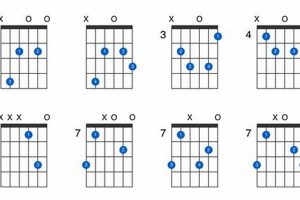
In the realm of guitar chord progressions for beginners, chord notation serves as the musical language that translates complex sounds into easy-to-understand symbols. These symbols provide a clear roadmap for guitarists to navigate the fretboard and execute chord progressions with precision.
- Simplified Representation: Chord symbols simplify the complex structure of chords, making them accessible to beginners. Each symbol represents a specific combination of notes, allowing guitarists to quickly identify and play the desired chord.
- Chord Identification: Chord symbols provide a concise way to identify the root, quality, and any alterations of a chord. For instance, the symbol “C” indicates a major chord with the root note C, while “G7” represents a dominant seventh chord with the root G.
- Progression Analysis: Understanding chord notation is essential for analyzing and comprehending chord progressions. By interpreting the symbols, guitarists can identify the sequence of chords used in a song and understand their harmonic relationships.
- Communication and Collaboration: Chord notation facilitates communication and collaboration among musicians. When sharing chord progressions or songs, musicians can use chord symbols to convey the exact chords to be played, ensuring a consistent interpretation.
Overall, chord notation is an indispensable aspect of guitar chord progressions for beginners. It provides a standardized method for representing chords, enabling guitarists to learn, communicate, and explore the world of music with greater ease and precision.
3. Common Progressions

In the realm of guitar chord progressions for beginners, understanding common progressions is a crucial step towards mastering the art of creating harmonious and engaging music. These progressions serve as the building blocks of countless songs across various genres, providing a solid foundation for aspiring guitarists to explore their musical creativity.
- Tonal Center and Harmonic Movement: Common progressions establish a clear tonal center and guide the harmonic movement of a song. The I-IV-V progression, for instance, creates a sense of stability and forward motion, while the I-V-vi-IV progression provides a more dynamic and contrasting harmonic journey.
- Emotional Expression: Different progressions evoke distinct emotional responses. The I-IV-V progression often conveys a sense of happiness and optimism, whereas the I-V-vi-IV progression can elicit feelings of longing or sadness. Understanding the emotional impact of progressions empowers guitarists to create music that resonates with their intended audience.
- Song Structure and Form: Common progressions play a vital role in shaping the structure and form of a song. The verse-chorus-bridge format, for example, typically employs a specific set of progressions that contribute to the overall flow and impact of the song.
- Improvisation and Soloing: Common progressions provide a harmonic framework for improvisation and soloing. Guitarists can use these progressions as a starting point to explore different melodic and rhythmic ideas, developing their improvisational skills and creating unique and expressive solos.
In summary, familiarizing oneself with common guitar chord progressions is essential for beginners to lay a solid foundation for their musical journey. These progressions provide a roadmap for creating harmonious and engaging music, expressing emotions, shaping song structure, and fostering improvisation. By mast
ering these progressions, guitarists can unlock a world of musical possibilities and take their playing to the next level.
4. Chord Families

In the realm of guitar chord progressions, understanding chord families is a fundamental concept that unlocks a deeper level of musical comprehension and expression for beginners. Chord families consist of chords that share a common root note and scale, creating a harmonious and cohesive sound within a specific key.
- Tonal Unity and Stability: Chords within the same family naturally complement each other, providing a sense of tonal unity and stability. Beginner guitarists can use this knowledge to create progressions that flow smoothly and sound pleasing to the ear.
- Harmonic Exploration: Exploring different chords within a family allows beginners to expand their harmonic vocabulary. By experimenting with major, minor, seventh, and extended chords, guitarists can create more diverse and expressive progressions.
- Chord Substitution and Inversion: Understanding chord families empowers beginners to make effective chord substitutions and inversions. This technique enhances the variety and sophistication of progressions while maintaining harmonic consistency.
- Songwriting and Composition: Familiarity with chord families is essential for songwriting and composition. It enables beginners to create chord progressions that support and enhance melodies, creating more cohesive and impactful musical pieces.
In conclusion, exploring relationships between chords within the same key through the concept of chord families is a crucial step for beginner guitarists to master guitar chord progressions. It fosters a deeper understanding of harmony, expands harmonic possibilities, and lays the foundation for creative songwriting and composition.
5. Inversions

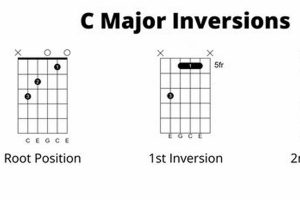
In the realm of guitar chord progressions for beginners, understanding inversions is a valuable technique that enhances both the harmonic and melodic possibilities of playing chords. Inversions involve rearranging the notes of a chord to create different voicings, expanding the sonic palette available to guitarists.
- Harmonic Embellishment: Chord inversions add harmonic depth and variation to progressions. By altering the order of the notes, guitarists can create richer and more complex soundscapes.
- Smooth Voice Leading: Inversions facilitate smoother voice leading, ensuring a natural and seamless flow of melodies and harmonies. This technique helps to avoid awkward voice crossings and dissonant intervals.
- Extended Range and Flexibility: Inversions extend the range of available voicings, allowing guitarists to explore higher and lower positions on the fretboard. This flexibility enhances the melodic possibilities and enables more creative and expressive playing.
- Bassline Creation: Inversions can be used to create interesting and dynamic basslines. By placing the root note in different voices, guitarists can emphasize different melodic contours and rhythmic patterns.
In summary, mastering inversions is an essential aspect of guitar chord progressions for beginners. It empowers guitarists to embellish harmonies, ensure smooth voice leading, expand their range, create compelling basslines, and ultimately elevate their musical expression.
6. Practice and Memorization

In the realm of guitar chord progressions for beginners, practice and memorization are intertwined concepts that pave the path to progress and proficiency. Effective practice techniques lay the foundation for developing muscle memory, enhancing coordination, and internalizing chord shapes, ultimately leading to seamless and effortless execution.
- Regular and Focused Practice: Consistent and dedicated practice is paramount. Allocate specific time slots for practicing chord progressions, ensuring regular engagement with the guitar.
- Chunking and Repetition: Break down complex progressions into smaller chunks and practice them repeatedly. Repetition helps solidify the sequence in your muscle memory.
- Slow and Gradual Progression: Avoid rushing into playing fast. Start slowly and gradually increase the tempo as your proficiency grows.
- Use a Metronome: Incorporate a metronome into your practice to improve timing and maintain a consistent rhythm.
- Active Listening: Pay close attention to the sound of the chords you play. This auditory feedback helps identify areas for improvement and refine your technique.
By embracing effective practice techniques, beginner guitarists can accelerate their progress, enhance their memorization abilities, and develop a solid foundation for mastering guitar chord progressions.
7. Key Changes
In the realm of guitar chord progressions for beginners, understanding key changes is a pivotal skill that unlocks the door to a wider harmonic landscape. Key changes allow guitarists to modulate from one key to another, adding depth, variety, and emotional impact to their music.
Key changes are often employed in guitar solos, bridges, and choruses to create a sense of movement and progression. By transitioning between closely related keys, guitarists can maintain harmonic coherence while introducing fresh and exciting sounds.
To master key changes, beginners should focus on the following aspects:
- Circle of fifths: The circle of fifths is a graphical representation of the relationship between keys. By understanding the circle, guitarists can easily identify closely related keys and make smooth transitions.
- Common chord progressions: Certain chord progressions, such as the I-IV-V progression, can be used to facilitate key changes. These progressions provide a natural bridge between keys, creating a seamless harmonic flow.
- Parallel keys: Parallel keys share the same root note but have different qualities (major or minor). Transitions between parallel keys often involve simple chord substitutions, making them a beginner-friendly approach to key changes.
Understanding key changes not only enhances a guitarist’s technical abilities but also expands their creative potential. By incorporating key changes into their progressions, beginners can add depth, interest, and a professional touch to their music.
Table: Practical Applications of Key Changes
| Scenario | Key Change Technique | Effect |
|---|---|---|
| Creating a dynamic solo | Transition to a higher key for a brighter, more energetic sound | Adds excitement and momentum to the solo |
| Modulating to a contrasting chorus |
Change to a key with a different e motional quality (e.g., major to minor) | Creates a sense of contrast and emotional impact |
| Extending a song’s harmonic range | Incorporate key changes throughout the song | Adds variety and prevents the progression from becoming monotonous |
8. Song Application
Within the realm of guitar chord progressions for beginners, the ability to apply these progressions to real-life songs is a crucial step towards practical musicianship. It transforms theoretical knowledge into tangible musical expression, allowing beginners to experience the joy of creating their own music.
Applying chord progressions to songs offers several key benefits:
- Enhanced Understanding: By attempting to recreate existing songs, beginners reinforce their comprehension of chord progressions and their practical application.
- Stylistic Exploration: Different songs utilize diverse chord progressions, exposing beginners to a wide range of musical styles and broadening their harmonic vocabulary.
- Performance Skills: Practicing real-life songs develops coordination, timing, and the ability to transition smoothly between chords.
- Creative Inspiration: Analyzing and playing songs by other artists can spark creative ideas and inspire original compositions.
To effectively apply chord progressions to songs, beginners should:
- Choose Simple Songs: Start with songs that use basic chord progressions, such as I-IV-V or I-V-vi-IV.
- Identify the Key: Determine the key of the song by listening to the melody and finding the root note of the chords.
- Practice the Progression: Play the chord progression repeatedly until it becomes familiar and comfortable.
- Add Embellishments: Once the basic progression is mastered, try adding embellishments such as strumming patterns, fingerpicking, or lead guitar lines.
By applying these principles, beginners can gradually develop their ability to play a diverse repertoire of songs and expand their musical horizons.
Table: Examples of Beginner-Friendly Songs for Chord Progression Practice
| Song Title | Artist | Key | Chord Progression |
|---|---|---|---|
| “Smoke on the Water” | Deep Purple | G | I-V-vi-IV |
| “Sweet Home Alabama” | Lynyrd Skynyrd | G | I-IV-V |
| “Stand by Me” | Ben E. King | C | I-vi-IV-V |
9. Improvisation
In the realm of guitar chord progressions for beginners, improvisation stands as a pinnacle of musical expression, where guitarists transcend the confines of structured progressions and venture into the uncharted territory of spontaneous creation. Improvisation empowers beginners to unleash their creativity, develop their musical intuition, and forge a deeper connection with their instrument.
The art of improvisation requires a solid foundation in chord progressions. By understanding the harmonic relationships between chords, beginners can create cohesive and meaningful musical phrases. Chord progressions provide a framework within which improvisers can explore different melodic ideas, rhythmic variations, and harmonic embellishments.
For instance, consider the ubiquitous I-IV-V progression. This simple yet powerful progression serves as an ideal starting point for improvisation. Beginners can experiment with different scales and arpeggios over the progression, gradually expanding their melodic vocabulary and developing a sense of harmonic direction.
As their proficiency grows, beginners can venture into more complex progressions, incorporating secondary chords, chromaticism, and extended harmonies. These advanced techniques open up a vast sonic landscape, allowing improvisers to create sophisticated and expressive solos.
The benefits of improvisation for guitar chord progressions beginners are multifaceted:
- Enhanced Creativity: Improvisation fosters creativity by encouraging guitarists to think beyond predetermined patterns and explore new musical possibilities.
- Improved Musical Intuition: The act of improvising sharpens a guitarist’s musical intuition, allowing them to anticipate harmonic changes and make spontaneous decisions.
- Deeper Instrument Connection: Through improvisation, beginners develop a more intimate connection with their guitar, gaining a deeper understanding of its capabilities and their own technical abilities.
In conclusion, improvisation plays a vital role in guitar chord progressions for beginners. It provides a platform for creative expression, enhances musical intuition, and deepens the connection between the guitarist and their instrument. By embracing improvisation, beginners can unlock their full musical potential and embark on a lifelong journey of musical exploration and self-discovery.
10. Musicality

In the realm of guitar chord progressions for beginners, developing a deeper understanding of musicality is paramount. Musicality encompasses the ability to perceive, interpret, and convey musical expression through chord progressions. By grasping the impact of progressions on the overall musical experience, beginners can elevate their playing from merely playing chords to creating evocative and meaningful music.
Musicality in guitar chord progressions begins with understanding how chords interact to create harmonic movement. Different progressions evoke distinct emotions and convey specific musical ideas. For instance, the I-IV-V progression exudes a sense of stability and resolution, often used in pop and rock music. Conversely, the I-vi-IV-V progression creates a more somber and introspective mood, commonly found in blues and folk music.
Beyond harmonic movement, musicality involves comprehending the relationship between chords and melody. Well-crafted chord progressions support and enhance the melody, creating a cohesive and captivating musical tapestry. By considering the melodic contour and phrasing, beginners can choose progressions that complement and elevate the melody, rather than overpowering or detracting from it.
Furthermore, musicality encompasses the ability to use chord progressions to create dynamic and engaging arrangements. Varying the strumming patterns, incorporating embellishments, and experimenting with different voicings can add depth and interest to progressions. Beginners should explore different rhythmic and textural possibilities to discover how they can shape the overall mood and impact of their music.
Developing musicality takes time and practice. Active listening to diverse musical genres, analyzing the chord progressions used by great musicians, and experimenting with different combinations are all valuable practices for beginners. By immersing themselves in the language of music, beginners can refine their understanding of musicality and incorporate it into their own
guitar playing.
| Understanding Musicality | Benefits for Guitar Chord Progressions |
|---|---|
| Emotional Expression | Evokes specific emotions and conveys musical ideas |
| Melodic Support | Complements and enhances the melody |
| Dynamic Arrangements | Creates depth and interest through varied strumming patterns and embellishments |
FAQs on Guitar Chord Progressions for Beginners
This section addresses frequently asked questions and misconceptions surrounding guitar chord progressions for beginners, providing clear and informative answers.
Question 1: What is a chord progression, and why is it important?
A chord progression is a sequence of chords played in a specific order. It provides the harmonic foundation for a song, creating a sense of movement and progression. Understanding chord progressions is essential for building a strong foundation in guitar playing and songwriting.
Question 2: How can I learn to play chord progressions?
Start by learning basic open chords and practicing simple progressions like I-IV-V. Gradually incorporate more complex chords and experiment with different voicings and strumming patterns. Practice regularly and use online resources or a guitar teacher for guidance.
Question 3: Can I use the same chord progressions for different songs?
Yes, many chord progressions are commonly used across different genres and songs. However, varying the voicings, rhythms, and embellishments can create unique interpretations.
Question 4: How do I create my own chord progressions?
Experiment with different chord combinations and listen to how they sound together. Study music theory to understand the relationships between chords and scales. Don’t be afraid to break away from conventional progressions and explore new harmonic possibilities.
Question 5: What are some common mistakes beginners make when playing chord progressions?
Rushing through chord changes, not muting strings properly, and playing sloppy transitions are common mistakes. Focus on accuracy, timing, and clean execution.
Question 6: How can I practice chord progressions effectively?
Practice slowly and gradually increase the tempo. Use a metronome to improve your timing. Break down complex progressions into smaller chunks and work on them separately. Regular practice and patience are key to mastering chord progressions.
In conclusion, understanding and mastering guitar chord progressions is a fundamental aspect of guitar playing. By addressing common questions and misconceptions, this FAQ section provides a solid foundation for beginners to embark on their musical journey with confidence.
Transition to the next article section:Exploring Different Keys and Chord Families
Tips for Mastering Guitar Chord Progressions for Beginners
Embarking on a musical journey with the guitar requires a solid grasp of chord progressions. Here are some valuable tips to help beginners navigate this essential aspect of guitar playing:
Tip 1: Start with the Basics
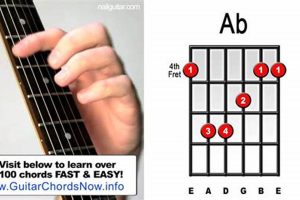
Begin with learning basic open chords such as C, G, D, and Em. Practice transitioning smoothly between these chords to build finger coordination and muscle memory.
Tip 2: Understand Chord Structure
Grasp the structure of chords by identifying the root, third, and fifth notes. This knowledge will empower you to construct and analyze chord progressions effectively.
Tip 3: Practice Regularly
Regular practice is crucial for mastering chord progressions. Dedicate time each day to practice transitioning between chords, improving your accuracy and timing.
Tip 4: Use a Metronome
Incorporate a metronome into your practice routine to develop a consistent rhythm. Playing along with a metronome enhances your timing and overall musicality.
Tip 5: Experiment with Different Voicings
Explore different voicings of the same chord to add variety and interest to your progressions. Experiment with inversions and different fingerings to expand your harmonic possibilities.
Tip 6: Analyze Songs
Study the chord progressions used in your favorite songs. Analyze how the chords interact and contribute to the overall melody and mood. This analysis will enrich your understanding of chord progressions and their practical application.
Tip 7: Seek Guidance
Consider seeking guidance from a guitar teacher or online resources. A qualified instructor can provide personalized feedback, accelerate your progress, and introduce you to more advanced techniques.
Conclusion
Mastering guitar chord progressions is a journey that requires dedication, practice, and a willingness to explore. By following these tips and immersing yourself in the world of guitar music, you will lay a solid foundation for your musical endeavors and unlock a vast repertoire of harmonic possibilities.
Conclusion
The exploration of guitar chord progressions for beginners has illuminated the fundamental principles and practical techniques that underpin this essential aspect of guitar playing. By understanding the structure of chords, practicing regularly, experimenting with different voicings, and analyzing songs, aspiring guitarists can unlock a world of harmonic possibilities.
Mastering guitar chord progressions is a continuous journey that requires dedication, patience, and a passion for music. As you progress, you will discover new and exciting progressions that will enhance your playing and inspire your creativity. Embrace the journey, continue to practice and explore, and let the guitar be your guide to a fulfilling musical experience.